
The company informs the international nurse in an audience-appropriate way about social insurance law in Germany; in particular pension, health, long-term care and unemployment insurance and how they can find out more.
- Social insurance law in Germany
The German social insurance network is based on the principle of the community of solidarity, or solidarity.
What does that mean in detail and what is different from some countries of origin?
As soon as you conclude an employment contract in Germany, you automatically become a member of various insurance schemes.
These are:
- pension insurance
- health insurance
- long-term care insurance
- unemployment insurance
Accordingly a fixed percentage of your salary is deducted directly from your pay as social insurance contributions. These contributions flow into the social insurance funds.
Currently the social contributions as percentages are:
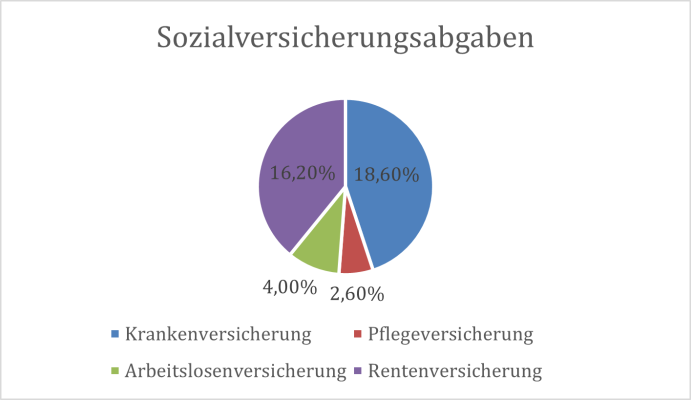
In return, thanks to the insurance schemes you receive financial support if you fall ill or lose your job.
You should therefore not be surprised if you do not receive the remuneration stated in the employment contract.
We will already answer questions on this in your country of origin, and of course also after you have entered the Federal Republic of Germany.
What are these individual insurance schemes and what purpose do they serve?
The important point first: the contributions paid in are not lost; they now serve to secure your livelihood.
Pension insurance
Statutory pension insurance is the branch of social insurance that serves old-age provision. Pensions for reduced earning capacity, survivors’ pensions and rehabilitation benefits to maintain earning capacity are also provided by statutory pension insurance.
Unemployment insurance
Unemployment insurance is financial support for people who are unemployed. It secures the basic income of those affected. It is part of statutory social insurance and thus a compulsory insurance scheme.
The best-known benefit of statutory unemployment insurance is unemployment benefit (Arbeitslosengeld), the wage replacement during unemployment. In addition, unemployment insurance also includes benefits for vocational rehabilitation and support in taking up employment and training relationships.
Unemployment insurance is one of the social insurance schemes whose primary aim is to secure income for jobseekers while they look for work.
A further important task is also to support unemployed people where needed with their further training and continuing education.
Health insurance
The task of health insurance is to maintain or restore the health of insured persons or to improve their state of health, and to inform and advise insured persons and encourage a healthy lifestyle.
The statutory health insurance funds are so-called “communities of solidarity”. That means all members pay into the system according to their ability to contribute (income), from which poorer or destitute members are also provided with the same uniform benefits.
Long-term care insurance
Long-term care insurance was introduced on 1 January 1995 as an independent branch of social insurance. There is a comprehensive insurance obligation for all persons with statutory and private insurance. Everyone who has statutory health insurance is automatically insured in social long-term care insurance. Long-term care insurance serves to cover the need for care.
- Where else can you find information on this topic
As an example you can find detailed information on the website:
https://www.make-it-in-germany.com
To get an idea of how much net pay you can earn, use the website of the Bundesministerium der Finanzen (Federal Ministry of Finance) – tax calculator